
It was slow where it mattered
Mobile scored 60 for Performance. Largest contentful paint took 6.2 seconds — well past the 2.5 seconds Google treats as the threshold for a good experience.
Florida, USA · Remote
Rebuilding a wellness website that customers couldn't use.
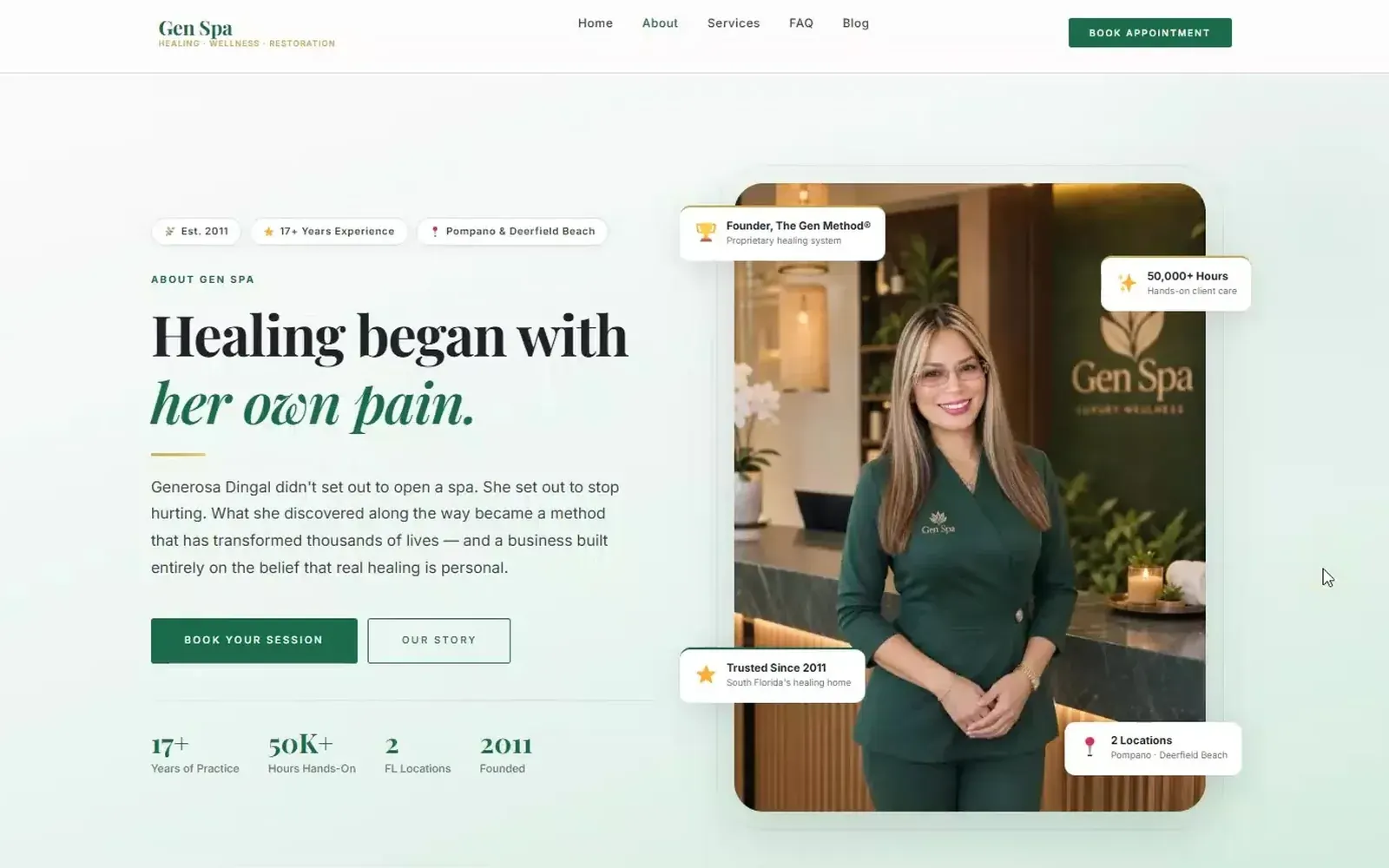
Gen Spa is a therapeutic massage and wellness business with two Florida locations. Its website looked established but was working against the business: slow on mobile, inconsistent between pages, and carrying a video library where much of the content no longer played.
I rebuilt it page by page in WordPress and Elementor, handling design, content, structure, and speed together rather than as separate jobs.
I led the website strategy, page structure, WordPress implementation, content updates, SEO, technical QA and publishing.
A slow, inconsistent site with a broken Video Library and a page serving the wrong content entirely.
Rebuilt ten pages, reconstructed the Video Library from scratch, and restructured content around what customers actually needed to decide.
Homepage, mobile, lab data. Google PageSpeed Insights Performance 60 → 92 and Accessibility 89 → 100, largest contentful paint 6.2s → 2.4s. After-report dated 29 July 2026.
Context
Gen Spa operates two massage and wellness locations in Pompano Beach and Deerfield Beach, Florida. The business itself was in good shape. The website was not.
I worked from the mobile view, because that is what PageSpeed measures and where the layout problems were worst. Three things a visitor commonly needs — what a treatment costs, who is qualified to deliver it, and how to book — were all harder to reach than they needed to be.
The challenge
Mobile scored 60 for Performance. Largest contentful paint took 6.2 seconds — well past the 2.5 seconds Google treats as the threshold for a good experience.
Layout, tone, and structure shifted between pages, so the site read as several different businesses rather than one.
A plain grid of embeds, several of them private or unavailable. Visitors clicked into content that wouldn't play.
The Social page URL was returning an unrelated blog article — a dead end for anyone trying to find the business on social platforms.
Rebuilding everything simultaneously would have meant a long window where nothing was finished. I started with the Video Library instead: it was the most visibly broken, it was self-contained, and fixing it first gave the client something complete to react to before I touched the pages carrying booking traffic.
Featured sub-project
The clearest example of the whole approach, contained in a single page. I owned the structure, content organisation, video presentation, archive handling, calls to action, disclaimer copy, and footer.
The original page relied on a basic grid of embeds. Several were private or removed, and nothing explained what the videos were or why a visitor should watch them.
Deleting the unavailable footage would have been faster. But the archive is part of the business's history, and quietly removing it would leave returning visitors wondering where it went. Moving it into a labelled archive section with a disclaimer kept the content honest and stopped it from undermining the current material.
Across the site
With the Video Library finished, I worked through the rest of the site. Where a before screenshot exists, it is shown alongside the rebuild.
Pricing sat in prose, spread across the page and hard to compare. Restructuring it into a scannable grid meant a visitor could answer "can I afford this?" without reading a paragraph.
On the original page the navigation menu rendered on top of the body copy — a layout bug that made the page difficult to read on smaller screens.
These pages had no usable before screenshot, so the rebuilds are shown on their own.
In a regulated service, "are these people actually licensed?" is a real objection. It was previously answerable only by reading the footer. A dedicated page gave that proof somewhere to live, somewhere to link to, and something for search engines to index.
Results
Google PageSpeed Insights, genspa.com homepage, mobile. The after report is dated 29 July 2026 and shows its own date, URL and device. The baseline capture is cropped above its header, so its date is not visible in the image; the project record puts the starting mobile Performance at 59–60.
The numbers above are technical measurements. The after report is self-evidencing — its date, URL and device are visible in the screenshot. The baseline screenshot is cropped above its header. I do not have verified data on traffic, bookings, leads, or revenue for this project, so I make no claim about them. If that data becomes available and can be evidenced, it will be added here.
What this demonstrates
The most useful work on this project wasn't visual. It was noticing that a page URL was serving the wrong article, that pricing was buried, and that a library of broken videos was doing more harm than an empty page would have.
A redesign that only changed how the site looked would have left all three in place.